Sunday, February 23, 2014

Blue Exorcist on Toonami; 1:30 AM Timeslot

With Blue Exorcist having aired yesterday on popular animation block “Toonami” I figure now would be a good time to talk about this show I’ve come to love so much. I anticipate that many fans are going to be getting into the series just now and I would like to take the time to initiate people who aren’t prepared for what they are going to be watching.

The reason I say this is because Toonami has decided to make a commercial spot prior to the airing of the show that seems to offer promises that the show has no intentions of living up to. While most of the plot remains intact there are several issues that I wish to lay down for anyone who is considering watching this series.

First of all, Blue Exorcist is an action comedy, and the main focus is not fighting demons. This is one of many things that bothered me deeply about the advertisement that was run, as Blue Exorcist has a lot of depth to it that may be missed by someone seeing the trailer. The series is somewhat short and there are no singular battles that last any extended amounts of time. Yes, some arcs take a prolonged time, but that is because the series is telling a story more than it is telling a fight scene.

What Blue Exorcist is is a show about finding one’s place in the world even with the odds stacked against you. While I won’t go too much into detail seeing as only one episode has aired on television so far, I won’t skirt around the issues that have been stated outright either by the trailer or the first episode.

Rin is a half-demon and the son of Satan, the bane of all exorcists. Despite this the first episode shows that he’s not a bad guy. He’s not intelligent, he’s not popular, and he’s a bit of a loser. He gets into fights often and can’t seem to hold down a job for more than a day or two. He has freakish strength, however, and is an earnest and hard worker, as well as an overall nice guy.

The show tries to balance out Rin’s life as both a human and a demon, as he comes to terms with the fact of who he is. He is aware that most people likely would have been happier had he never been born. And yet he decides to power through and make a way for himself in this world that has no need for him. He doesn’t decide to become an exorcist to save his own life or to thin out some upcoming demon invasion as the ad would have you believe. He becomes an exorcist because that is the only way he feels he can move forward with his life.

The fight scenes in the series are good and rather interesting, but that is far from the show. The show centers mainly on its characters and their inner struggles, less on the action adventure demon fighting. Many of the episodes feature no fighting at all and very little in the way of demons, but you’re given a glimpse into the characters and their way of life. You get to know what drives them and what makes them who they are. What insecurities they carry with them and what baggage is hanging on their shoulders.

Of course with only a modest number of episodes to run through the show is far from a completed story, but it serves as a good springboard into the manga which is still going strong. While the anime focuses mainly on Rin and Yukio the manga spares more time for the other characters, dealing with their problems and watching as they struggle to continue moving forward despite them.


I am hoping people enjoyed what they saw on Toonami last night, and I sincerely hope they stick around to see all the potential that this show has.


Friday, January 17, 2014

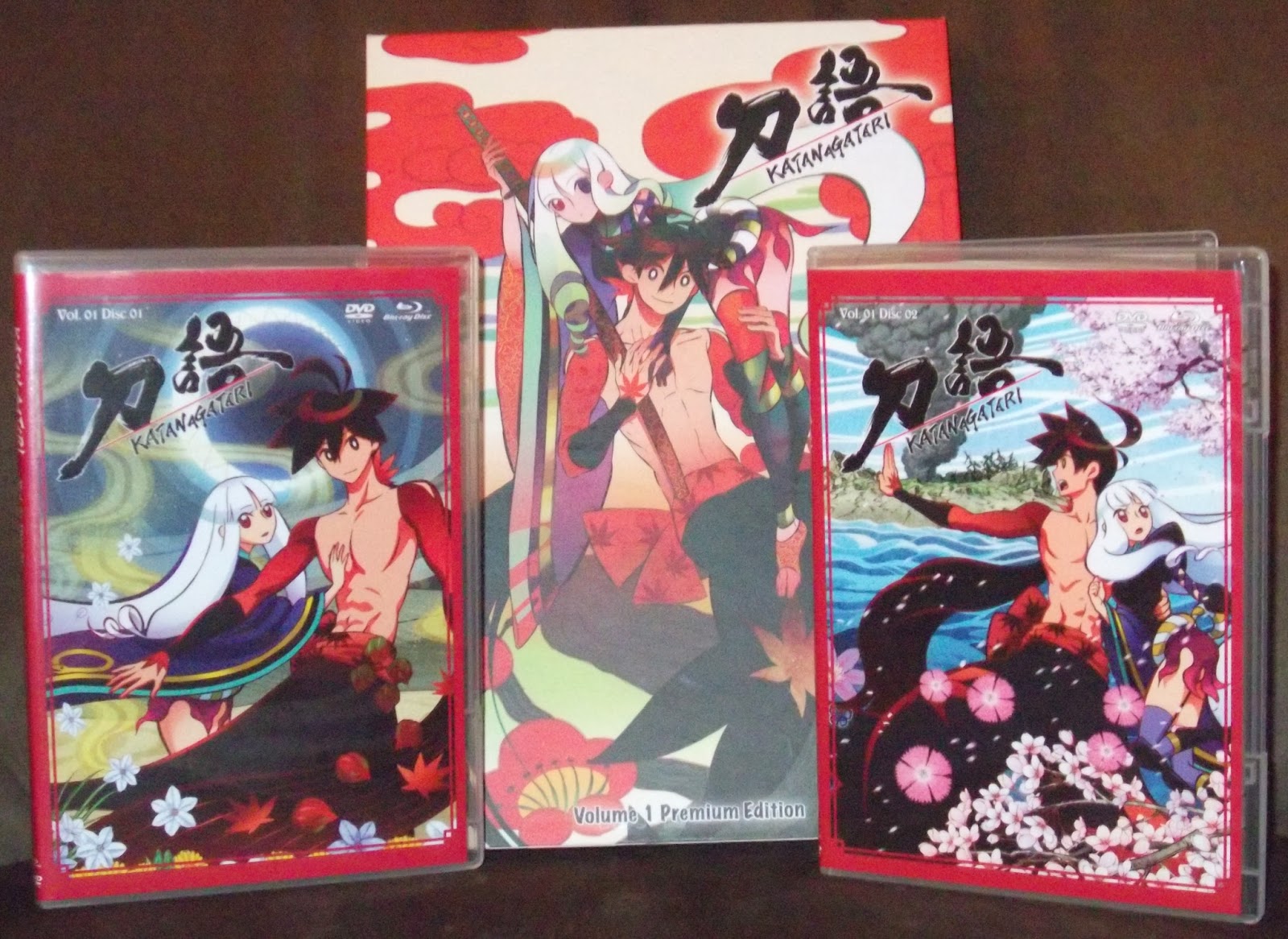
Katanagatari: Volume One Premium Edition (Blu-ray/DVD Combo) - An appreciation of unusual aesthetics

The Katanagatari: Volume One Premium Edition (Blu-ray/DVD Combo) pack is a beautiful way to appreciate the rather unique yet beautiful animation that the series itself employs. While the style may seem simple at first it carries with it an elegant charm, and the illustrations on the box are rather beautiful and highly stylized.


The box itself is rather large, standing tall enough to hold both DVD/Blu-rays one on top of another instead of one behind the next. It's a rather intimidating box that doesn't fit well on a DVD shelf, which is only natural as the case itself is intended to be displayed. If you're looking just to possess the series itself this likely isn't the way to go, but the extra features are well worth it.


The box itself is rather sturdy cardboard with beautiful illustrations wrapped around it. The front and back feature art from the series, which is modeled after more traditional Japanese art as opposed to the more common digital art style that is prevalent in series these days. It carries an entirely different aesthetic than most anime series. It is a nice display piece even if you find you aren't a fan of the series.


Each of the DVD/Blu-rays is decorated with a more straight-forward piece of art from the series proper. The DVDs and Blu-rays are decorated with a rather simple image of a leaf over the center of the disc. While DVDs recently have featured somewhat extravagant art, the simplicity of the discs fits well with the series proper.

As far as the DVD/Blu-rays themselves are concerned, there isn't much in the way of extras aside from the creditless opening and endings, which is more impressive than it sounds since each episode of the series features a new ending. That brings the total of extra videos to seven, as there are six episodes in the first half of the series. The series itself is only in Japanese with English subtitles, so there's no option for people who dislike reading subtitles. It shouldn't be a problem, however, and the lack of a dub track makes the set cheaper than it would be otherwise. The only real issue is the fact that the Blu-ray discs feature smaller subtitles than the DVD episodes, but it shouldn't be much of a problem.


The series also comes with an artbook which features not only short recaps of the episodes included in the set but also a few illustrations near the back that aren't related to the episodes themselves. The episode recap pages also feature illustrations on the opposite page, giving episode-specific art as well as the unrelated pictures near the end.


The series itself is rather beautiful and features an entertaining cast of characters, and is well worth the money spent to purchase this collection. The lead character is another of your idiot protagonists, but more than just being an idiot he's clueless. He accepts things as they are and easily gives in to his companions' corrections. Even the leading female's insistence that he finish their enemies with a flare is taken to heart almost immediately.

Overall it's a series I would recommend to anyone who is a fan of the arts as well as anime in general. It is visually pleasing in all regards and the story is interesting in its many unusual interpretations of what it is to wield a sword of unusual power.

There are two parts to this set, both of which you can purchase here:

Wednesday, January 15, 2014

Weiss Schwarz Trial Decks - Puella Magi Madoka Magica and Fate/Zero

Weiss Schwarz is a card game that has yet to make it into the mainstream circuit, but that doesn't mean that it isn't an enjoyable game in and of itself. Those people who have heard of it likely aren't aware that several of the decks have already been translated into English, although compared to the selection of decks in Japanese the number released to American markets. So far the Puella Magi Madoka Magica, Fate/Zero, and Sword Art Online trial decks are the biggest ones that have been released to the American markets, but translations for other series are available online for those who wish to play the game using their favorite series. Nippon Ichi America has also advertised their Disgaea starter deck in the past, but as I don't personally own it I cannot speak as to whether or not it has been translated into English or not.

The game itself is somewhat difficult to pick up on your own but there are tutorials available on the internet that will make learning much easier. Once you've gotten hang of the game it isn't really too terribly difficult, although learning precise turn order can be a bit of a task. While I'm not going to explain how to play the game in depth I will give the very basics before talking about the decks themselves. Certain terms will be useful to know when it comes to talking about the cards themselves, after all.

The basic point of the game is to force your opponent to level 4. In order to do this you must do 7 points of damage to your opponent over the course of each level, beginning with level 0. However as levels increase more powerful cards can be played, meaning that if you push your opponent to a high level too quickly without taking much damage you may find yourself suddenly overwhelmed by a slew of powerful cards. Cards can only be played once you have reached their level, meaning that a level 2 character can only be placed on the stage once you've reached level 2, although you may also play level 1 and level 0 characters.

In order to play most higher level cards, however, you must pay a tribute from your stock. Your stock is built up by attacking and through various cards throughout the game. It is important to keep a decent balance of stock so that you can summon characters as you level up, but to not have too many so that your deck remains well stocked.

The only other important term is 'climax cards' which act as general power-ups for your characters.

Now that we've gotten the basics out of the way we can review the decks themselves.

The first and probably most important thing to note about these decks is that they are predominantly catered towards those who are fans of the series which they represent. While it isn't impossible to play the game without knowledge of the series proper it is a bit of a deterrent. Thankfully the trial deck for both games manages to skirt the issue of major spoilers. There are bound to be spoilers here and there, of course, but the trial decks at least manage to keep these issues at bay.

Most of the cards themselves are composed of the art, which is not necessarily the standard way for cards to go. Instead of the pictures being relegated to a small section of the card the actions and details are written in a small space that overlaps the bottom of the picture. This is a rather nice change from most card games which follow the format of keeping the art and the play details separate. As the game is intended for fans to play together with their favorite series it is no surprise that showing off the artwork comes as such a priority. The Japanese name of the card is also preserved in both decks, leaving a neat connection to the original card itself.

As I personally have more experience with the Madoka deck I will be reviewing that first.

Puella Magi Madoka Magica:

The deck itself centers itself around Madoka and Homura for the most part, although you'll be surprised to find that most of your powerful cards tend to feature Sayaka. While the level 3 cards included in this deck are those of both Madoka and Homura, up until reaching this critical point you'll mostly be using cards featuring Sayaka. The most powerful climax card in the game is a tossup between one featuring Homura and one featuring Sayaka. While Homura offers a boost in power alongside the extra damage, Sayaka offers two points of extra damage as opposed to one. It is rather hard to remember that this deck isn't supposed to be Sayaka-central.

The art for the cards is typically rather bright and upbeat, making the card look overall much more pleasant and fun to play. The art is rather simple with most of the pictures coming from production art rather than simply from screenshots of the show. This leaves the backgrounds much lighter and less cluttered than other cards and makes for a rather beautiful deck. While there are cards which are simply screenshots (such as 'The Girl From the Dream' and 'Second Year Mitakihara Middle School, Sayaka') there are a great deal that come from promotional art ('Ordinary Girl, Madoka' and 'Smiling Sayaka').

This deck is a rather powerful one, with fairly easy to use cards with low costs coming out early in the game (most cards featuring Sayaka are at least 500 power higher than other cards of the same level). However the deck itself isn't perfect, as the inclusion of 4 level 3 cards leaves you rather hard up for lower level cards.

The deck, however, comes with a promotional Homura card at level 2 which can be used to take the spot of one of the level 3 cards. The promotional card is a level 2 with 8000 power, which in itself isn't much, but carries with it an action that allows you to add 2000 power to her by sacrificing one card in your stock. It isn't game-breaking but it is rather useful.

With the inclusion of this card, at the very least, you have the opportunity to modify the deck without having to buy any booster packs.

Fate/Zero:

The Fate/Zero deck follows all of the basic points mentioned above about card quality. Large illustrations decorate the cards, which feature a selection of prints both from screenshots of the anime and from promotional art. The deck centers itself around Saber, although there is a small selection of her in the beginning stages of play. In the many times I have fought against this deck it seems that early play focuses mainly on Waver and Irisviel, as there are multiple cards featuring these two at level 0. There is a card featuring Saber for each level, at least, meaning that it's possible to use her at all levels. The two level 3 cards included in this deck (there are 2, as opposed to the 4 in the Madoka deck) are both Saber, as well.

The game seems to spread itself rather well across all levels, meaning that you will likely have a card to play at all times if you don't rush through them too quickly. While the cards in the Madoka deck may seem more powerful than those in the Fate/Zero deck it's rather difficult to fill your stage with the unbalanced card numbers. There are very few level 2 cards in the Madoka deck, meaning it is difficult to lay down powerful cards once you and your opponent have reached this level. In the Fate/Zero deck, however, the cards seem to be nicely spread out over all four levels.


Saturday, January 4, 2014

Kingdom Hearts 1.5 ReMix Limited Edition (Playstation 3) - Enhanced graphics and an elegant artbook

Kingdom Hearts HD 1.5 Remix - Limited Edition is a great addition to the Kingdom Hearts collection that has seen another of its long dry spells. The long wait between numbered games is made tolerable with the scattered releases of side-games, although opinions on them vary from person to person. While Kingdom Hearts 1.5 isn't a new game it is a well-loved re-release.

The limited edition of the game comes together with an artbook complete with original character designs as well as the many different covers the games themselves have gone through. The artbook itself is built into the game case as well, meaning that it is impossible to misplace it even as the years go on. There is no danger of losing what it is that makes this version of the game so special. The case is a hard-cover book with the game held in the back. As well as the artbook the game comes with a special animated theme for your Playstation 3. While the theme isn't anything impressive as far as the graphics are concerned the menu of your system will take on the appearance and the sounds of the menu from the game proper. It's a rather charming addition to the game, in my opinion.

While some people may be disappointed with the fact that this is little more than an updated release of the first two games in the series alongside one of the less-loved side games there's plenty to love about this release even for those who have played the game before. First and foremost is the fact that the version of Kingdom Hearts included in this collection is the much desired "Final Mix" previously only available in Japan. While the multitude of extended story features were the subject of discussion during the original release of the updated game, several game play updates are also included in the 1.5 ReMix collection.

For those people who haven't played the original Kingdom Hearts game in a while, the controls likely won't seem all that new to you as it was remodeled after the second game. Reaction commands take the place of the original menu scrolling system that made things so awkward in the original game, and the camera controls have been shifted to the right analog stick as opposed to the shoulder buttons. It's much easier to swing the camera around with these new controls, but the camera is still pulled in rather close to the action and brings with it its own difficulties.

As well as updating the game controls several new enemies were added to each location, adding a new dimension of difficulty to the stages. While it's rather simple to kill most of the enemies with even a basic strategy all of the new heartless require specific patterns or move sets to kill. Some enemies require specific skills be used against them (such as several of them requiring the 'stop' skills in order to deal any damage). Learning the secrets behind each enemy and finding ways around them is a rather welcome addition to a game many have already played. On top of this, many of the secret heartless are rather difficult to kill. The Powerwild-based enemies in Traverse Town are particularly annoying, as they multiply endlessly as soon as they spot your character. Finding them in town when you aren't prepared is perhaps one of the most irritating occurrences.

The gummi ship system has also been reworked slightly in this edition of the game, adding missions that give the player a reason to actually play them more than once. However these don't have much bearing on the outcome of the game itself so people who still find these mini-games irritating are not forced to play them.

In regards to the Kingdom Hearts Re: Chain of Memories game included in this collection there isn't much that was changed from the original, accepting the addition of several new cards. If you watch the scenes from Kingdom Hearts 358/2 Days before playing this game you'll find a large collection of powerful cards previously not available.

In regards to the third game, there really isn't one. For those people who were dissatisfied with the Roxas-themed game 358/2 Days this collection allows the player to view the story without having to deal with the many irritations the game provided. Even better is the fact that each of the secret reports is unlocked after having watched the game, allowing the player to get the whole story without having to overcome the multitude of challenges the game originally required them to overcome.

Overall the game is well worth the money spent, especially considering the price of most Playstation 3 games. For less than most new games players can relive the early days of Kingdom Hearts in a way they haven't before. It is also a good chance for new players to get into the game, as the many issues that plagued the first game have been ironed out and the first two games are included, although it would likely be best if they played the second numbered Kingdom Hearts game before watching the scenes from 358/2 Days.


Thursday, January 2, 2014

Blue Exorcist: The Movie

For those people who have yet to see the Blue Exorcist anime the Blue Exorcist movie is not for you, but for those who have seen the series and enjoyed it I believe this is a wonderful addition to the series as it stands now. There have been those that criticize the movie for being less action-packed than anticipated, but there is no need to be so harsh.

For those people who haven't seen the series (one of my top ten recommendations) Blue Exorcist is a series that combines the daily lives of supernatural teenagers together with the action of their daily training as potential exorcists. Each student has his or her own individual talent that they bring to the classroom, together with their own personal burdens. The series is not solely focused on the physical struggles of the characters but also on their emotional struggles. Those people who expect something different from the movie are deluding themselves and robbing the series of what it is that makes it so great.

The movie itself focuses almost entirely on the struggles of the two main characters, Yukio and Rin Okumura, two people who have always had trouble fitting in. Both are pursuing their own brand of justice, although they have very different ways of looking at the problem. While the two are on a mission together Yukio's no-nonsense plan is ruined by Rin's (and to a lesser extent Shiemi's) emotional reaction to the plight of others. Due to their involvement Yukio's reputation is tainted and the target gets away. While Yukio tries to undo the damage his brother has caused Rin finds himself looking after a young demon he's found injured as a result of his actions.

The movie is far from action-packed but that isn't what fans of the series should go into this movie expecting. While the series is certainly not lacking in action, that has never been the point of the show. Blue Exorcist cares more for the relations between its characters than on the fights that take place between them. At its heart the series isn't about fighting demons, it's about finding acceptance. If you look at it that way the movie is a perfect continuation of what fans have come to love, although those people looking for more excitement may find themselves a little disappointed.

All-in-all I would recommend the movie to anyone who enjoyed the show, although those expecting something more than what they got in the original television run may be disappointed.

Wednesday, January 1, 2014

Tales of Symphonia Chronicles - Playstation 3, a classic remade and improved

Tales of Symphonia Chronicles for the Playstation 3 is one in a long line of HD re-releases that have been taking place these last few months. Square Enix has re-released at least two different collections (Kingdom Hearts, Final Fantasy X) and now Bandai Namco has stepped up to the plate with this collection.

For those people not familiar with the series, Tales of Symphonia was one of the first games that brought the "Tales" series into the foreground of J-RPG notoriety. These days the series is most well known for Tales of Vesperia, released exclusively for the X-Box 360 here in the United States. Many of the games only receive one release overseas, excepting Tales of the Abyss which recently received a port onto the Nintendo 3DS, even in North America. That isn't to say that there aren't ports for the other games. In fact, most games in the series are released for at least two systems. However these often don't make it over to the North American market.

The original Tales of Symphonia was released in North America in 2004, one of few RPGs that made it to the Nintendo Gamecube. The year after the series' original release a Playstation 2 port was released in Japan with extended features. However this port never made its way overseas and so these features were never released to North American audiences. However this HD release is based upon the Playstation 2 version, giving foreign audiences the opportunity to enjoy these upgrades (much as the Kingdom Hearts 1.5 ReMix collection allowed foreign audiences to enjoy Final Mix for the first time).

A fair deal of the changes involved with the Playstation 2 version of Tales of Symphonia are costume changes (a set of clothes from the snow city of Flanoir and character-specific costumes) there are some important changes that newer fans will recognize. The biggest change to the game proper is the inclusion of "Mystic Arts," specific skills that are only usable during certain conditions. While Lloyd had a secret move in the original game it was the only of its kind in the game. People who have played the sequel, Tales of Symphonia: Dawn of the New World will likely remember these if they ever included the original game characters in their party. These Mystic Arts will now be usable in the original game.

The sequel will also be released together with the original game, meaning that those fans of the original that hadn't had the opportunity to play its sequel can now buy it together with the series proper. Thankfully there wasn't much need for the motion controls in the original release of Tales of Symphonia: Dawn of the New World so moving systems over to the Playstation 3 shouldn't be much of a problem.

All in all I would suggest this game for fans of the Bandai Namco's "Tales" series. Anyone who appreciates a solid RPG should give this game a try as well, especially considering the price. The game releases this February and is a must for fans of the series.

Tuesday, December 31, 2013

Code Geass: Lelouch of the Rebellion, Part 1 (Limited Edition) - A sturdy case and rare collectibles included

The Code Geass: Lelouch of the Rebellion, Part 1 (Limited Edition) box may seem like a lot of money for what's not even the full series of Code Geass: Lelouch of the Rebellion, but what it does have is worth the extra money. With the release of a complete box set buying something like this may seem like a waste of money, but the box comes with a variety of extras that you won't find by purchasing the DVD box set. For first-time viewers of the show or casual fans of Code Geass: Lelouch of the Rebellion this collector's item may not be for you, but for those people who truly enjoy the world of Code Geass this box is more than worth it.


The first thing that should be noted is the case in which the DVDs come. While the first season box set comes in your standard bulk plastic case the Code Geass: Lelouch of the Rebellion Part 1 (Limited Edition) box is made of thick, sturdy cardboard decorated with beautiful artwork from the show. There is no side of the box which is not decorated, including the inside. A cloth strip is included to help you open the box, which has a convenient door that opens to reveal the DVDs stored inside. Even more convenient is that the door not only opens but also slides back into the box, making it possible to display your DVDs easily. The box is big enough to hold all of season 1, and since each DVD is in its own individual case there's no need to fumble with the layered DVDs that complete box sets deal with.


This is only the beginning of the extra features included in this box. Because there are more DVDs in the Japanese release of the series than in the American release the DVDs themselves come with more than one insert booklet. While this may seem silly at first there are extra stories in each book that would be lost if only some of them were released. Of particular note are the history lessons that the cast conducts at the end of each book and Sayaka's journal entries, which add a bit of depth to the everyday life of someone in the middle of the chaos that is Code Geass. I believe these are standard fare in the Code Geass: Lelouch of the Rebellion DVDs but their inclusion in this set is always appreciated. Also included with the DVDs is a booklet of character sketches.


So far I've only mentioned the DVDs themselves, but that isn't all that is included in this box. This first part of the series comes with the first manga issue of the Code Geass: Lelouch of the Rebellion series. Each Code Geass: Lelouch of the Rebellion (Limited Edition) comes with a manga included, but those are hardly the extras people get all excited about. The real icing on the cake here are the two CDs that come together with the set. While it may not seem like a lot just hearing that there are two CDs included, Bandai really went above and beyond with their release of this series.


The first of these two CDs is the first volume of the series' Original Sound Track (OST). This doesn't cover all of the music in Code Geass: Lelouch of the Rebellion, obviously (as it is only the first volume) but it contains much of the music that you hear during the show. For people who enjoyed the music of the series it is a very nice bonus to a very nice box. The real prize, however, is the second CD. The second CD is the first Code Geass: Lelouch of the Rebellion Sound Story. It is rare that these materials are released to an American audience, and each track on the CD adds either humor or insight into an episode of the show. In some cases the tracks actually provide information that comes before the series itself begins, giving new life to the series. These are audio CDs only and so each and every track was re-recorded with the American vocal cast for the series. Even if you aren't a fan of the show itself in English these CDs at least allow you to hear the extra material in a way that you can understand it.


This second CD is a rare collectible that few shows even offer, and the stories themselves range from humorous to serious, and from pointless one-shots to character-driven story-lines. If Bandai were still around I would urge each and every fan of the series to purchase this Code Geass: Lelouch of the Rebellion Part 1 (Limited Edition) but unfortunately my endorsement of their dedication to bring fans as much of the series as possible will never reach them. However I would still urge serious fans of the series to look into this option when purchasing the show. Following this Code Geass: Lelouch of the Rebellion Part 1 (Limited Edition) are part two and part three , each with included bonus materials (such as the second and third sound stories).


Monday, December 30, 2013

Top ten anime

I have been working lately on compiling a list of anime that I have seen in the past so that I can get input on what I should review next, but that has been taking a while and so I thought perhaps I should list my favorite anime to tide me over. I can't continue to neglect my blog, but it feels strange to randomly pick and choose anime to review.

Click to continue...

Friday, December 27, 2013

Top 5 Christmas episodes

So with the other day being Christmas (I've been working and sleeping since so I didn't have time to update anything) I decided that perhaps I'd take some time to list my top five favorite Christmas episodes, but to be fair I haven't seen much in the way of shows with that many Christmas episodes. I try to avoid shows without either a fair deal of humor or a fair deal of plot, so a majority of shows fall far outside of my personal taste range.

With that having been said, I'll begin with number 5 and end with 1. And now, without further ado, the list!


5. K-On!


K-On! isn't the type of show I typically watch, to be perfectly honest. It isn't as if I don't enjoy that sort of hyper-cute shoujo stuff, but I don't actively seek it out. However I have friends that rather enjoy watching every last adorable little show that comes out, despite the repetition inherent in such a hobby. Every now and then they manage to wrangle me into watching them. This one came up in club back in the olden days, which is why I've seen this episode.

K-On! is the sort of adorable show that I can't help but love, and the saccharine sweetness in this episode is enough to melt my cold little heart. Family moments in particular are always particularly moving, and seeing Yui and Ui's sisterly love is something I could watch any day. Throw in the rest of the cast being their adorable little selves and I just can't help but fall in love.


4. Ranma 1/2

Ranma 1/2 was one of the first shows I ever had the pleasure of watching outside of a televised medium, and I loved it. As a child I was always looking forward to if and when Ranma and Akane would finally fess up and voice their feelings, especially since it was so obvious that they cared about one another. As I grew older it lost its touch as I can only watch so many episodes of people tiptoeing around the obvious before I get bored. However there will always be a special little place in my heart that adores these two, and the OVA Christmas episode is one of the many reasons I still adore this couple despite my falling out with the show itself.

The typical elements of humor are there, of course, with Nabiki being her usual money-hungry self and Ryoga getting lost on simple errands. What really makes this such a memorable episode for me is the scene in which Ranma and Akane exchange presents, away from the prying eyes of the other party guests. Akane has made Ranma's gift by hand and, despite her clumsiness and the overall poor quality of the scarf itself, Ranma wears it anyway. It's a truly lovely scene between the two reluctant fiances.


3. Axis Powers Hetalia

Hetalia has had a lot of controversy flung its way in regards to its rather unique take on history. There are several different instances in which the countries celebrate and converse about Christmastime, but the introduction of Finland as Santa Claus is the first and most memorable. The scene takes place in the middle of what would realistically be a rather terrible battle, but instead we're treated to the countries themselves celebrating Christmas together.

What originally starts as a battle between the nations devolves into a last minute celebration between all the present countries due to Italy's remembrance of the holiday and his make-shift Christmas tree. At the end of his countdown he wishes all countries present a merry Christmas and Santa Finland makes his appearance to deliver gifts for everyone. America comments on how he was too busy focusing on the fighting to think about Christmas and the fight is temporarily forgotten in favor of the holiday.

Also, the embarrassment Germany's present brings him is rather humorous.

2. Persona 4

Alright, so I'll admit right here and right now that I don't really remember whether or not Persona 4 Animation had its own Christmas episode or not, but what I do remember rather vividly is the Christmas scene in the game itself and that's enough for me to add it to this list. Personally I loved the characters in this series rather dearly and so seeing them enjoying themselves was a real treat to me, especially considering the game itself has a rather serious tone.

Christmas takes place near the end of the game, meaning that the case has already been solved at this point. After several dramatic twists and turns the characters have been through a real emotional roller coaster, and Christmas is a time for them to enjoy themselves as normal teenagers.

Since I'm most familiar with the game rather than the series I will comment on how I personally enjoy the ability to choose your partners for the event. A personal favorite is the time spent together with all of the other male characters. Seeing the cast of characters laughing and joking around normally is refreshing, and Yosuke in particular has always been a favorite of mine. Kanji and Yosuke have always had a rather great bantering relationship, and that comes out here as well. All in all it's a rather adorable scene.


1. Minami-ke

What really makes an episode memorable in a series is the ability for it to move you. In a comedy series in particular this is a delicate balance to try and maintain, as the episode should both contain the usual humor mixed together with the heartwarming feelings of the holiday. Minami-ke manages to pull this off with flying colors, with both elder sisters working together for the sake of their youngest sibling. Flabbergasted that Chiaki doesn't believe in Santa Claus Kana takes it upon herself to fix this problem.

In order to do this Kana enlists the help of poor kicking boy Fujioka, who has been trying since the first episode to confess his feelings for Kana. Fujioka, of course, comes through for her and dresses the part of Santa so that her little sister can have a magical Christmas, and although he's right there Fujioka winds up leaving without giving Kana the gift he bought for her.

And come the next morning Chiaki is excited to have met Santa Claus, clinging happily to the teddy bear he brought her, before Kana begins teasing her for her childish belief in such things. Everything about the episode is sweet and hilarious all at once, from Kana's roundabout way of showing affection for her sister to poor Fujioka's inability to give Kana her present (and the many misunderstandings that come from it).

Tuesday, December 24, 2013

Let's see here

To be entirely honest I'm not really sure just what all I should be talking about at the moment, which isn't to say that I have no idea what I'm trying to do here. The issue is that I have a rather large backlog of anime and games that I have either finished or am currently watching and deciding which one I would like to talk about next is actually a rather difficult problem for me. At the moment I am trying to gather together a list of the anime that I have seen so that perhaps I can get some input on what I should be talking about at the moment.

If anyone has anything that they would like to hear my opinion on I would be more than happy to listen to any and all suggestions, although I cannot make any promises as to whether I have seen the show or not. In fact there is probably a fairly good chance that I haven't seen some of the more recent shows, but there are those I am looking for an excuse to watch. I would be interested in hearing what it is you would like to read about, instead of rambling about those shows I wish to talk about.

Although I do tend to have rather unique tastes. I'm doing my best to steer away from those things that most everyone has covered already, but I suppose I wouldn't mind taking a crack at them if that is what people would like.

Monday, December 23, 2013

Distractions...

Recently I've been pre-occupied with replaying Kingdom Hearts whenever I have free time. It isn't as if I'm trying to neglect this blog or anything--especially after promising myself that I would make it more active again--it's just that the release of Kingdom Hearts 1.5 has made me a little nostalgic. Currently I'm working my way through the second numbered game and then I suppose from there I'm going to actually take a stab at Dream Drop Distance. I've heard mixed reviews on the game, although most of my friends have a favorable opinion on it.

Personally I was rather happy with 1.5 despite there not being a whole lot of new content. I was a little disappointed that there was a trophy for beating each game on each level, as I tend to start playing on Proud mode and I wasn't really looking forward to playing Re:Chain of Memories six more times. However I managed to get all of the trophies and I am eagerly awaiting the release of Kingdom Hearts 2.5. As I replay Kingdom Hearts 2 I find myself continuing to try and gather 100% completion despite my desire to finish and continue on to the next game.

Friday, December 20, 2013

Anime Review: Legend of the Legendary Heroes

I suppose on occasion it might be in my best interest to write up a serious review, so without further ado I'll delve right into the main content of today's post. At the moment I'm looking at Funimation's Blu-ray boxset of Legend of the Legendary Heroes. We'll begin with the boring details and go into the series proper from there.

Legend of the Legendary Heroes
The Blu-ray two-part boxset offered by Funimation
Legend of the Legendary Heroes (2010) is a 24-episode series based on a series of light novels that have--as of now--only been released in Japan. This, unfortunately, means that the series is only the beginning of a much larger narrative. The Japanese vocal cast consists of Jun Fukuyama, Daisuke Ono, and Ayahi Takagaki as the three lead characters. To most die-hard anime fans these names should ring a bell and--if memorizing names isn't your thing--the voices should at least sound familiar to those who watch their anime in sub. The English dub features Ian Sinclair, Eric Vale, and Luci Christian. Many of these are familiar voices as well, to those who prefer to watch in dub.

As for the physical contents of the Blu-ray/DVD pack Funimation has put their effort into offering something more than the bare necessities but unfortunately there is little more than that. While the Blu-ray comes together with the DVD series (as is common these days) they offer little more than the usual extra features. Commentary and textless openings/endings are standard these days. The DVDs do, however, come with character cards in each. Personally I'm a little saddened to see Shion left out of the action. With three main characters it is unfortunate that only two of them come with the Blu-rays.

The limited edition of the first Blu-ray does, however, come with a nice box to store both cases in.
The Story: 
The series follows three characters each working towards the goal of creating a world in which they can all live peacefully. Ryner Lute is an idealist who has been persecuted his whole life due to the Alpha Stigma, a power that allows him to copy the magic of others. He dreams of an easygoing life spent napping while on his quest together with Ferris Eris to find the "hero relics" that will hopefully move the world towards peace. Meanwhile, Ryner's friend Shion Astal pursues his ambition to become the king of a kinder nation.

Overall Impression:
To begin with I'd like to make it clear that I enjoyed this show. I laughed, I cried, and I genuinely came to care about the characters throughout the course of the series. Now that we've gotten that out of the way I can speak more in detail about the show itself.

First and foremost I rather enjoyed the dub for this show. Since this blog was originally created with the intent of analyzing the differences between Japanese and English language tracks in anime series I thought perhaps it would be most fitting to begin here and work towards a final conclusion. Ian Sinclair truly brings the character of Ryner to life with his portrayal, and even the most simple of lines is delivered with just the right emotional level.

While on that topic, however, it should be mentioned that the emotional tone of the series can at times be rather jarring. What seems to be a rather generic fantasy comedy leads way to some rather dark scenes fairly early on. Legend of the Legendary Heroes does this often, which can come off a little hectic. Characters who appear in humorous scenes at the beginning of an episode may find themselves entrenched in a bloodbath by the end, although the series does take care to set the mood before any large jumps. Perhaps the most awkward of these instances, however, comes near the end of the series. What should be a building climax is surrounded by humor and a oft-forgotten yet slowly building unease.

The main issue this series has, however, is its lack of an ending. The series itself ends with the buildup to what would originally be another arc of the story, and gives the viewer something to look forward to (fans of the show are still desperately awaiting a second season). Unfortunately the source material cannot be found in the United States, meaning that this sendoff leads the audience straight into that ever present brick wall people call the language barrier. What is even more offensive, however, is the simple fact that the questions raised (in what was likely the first act in a series of books) are never answered. Vague hints are dropped here and there as to what it is that is going on near to the end of the series, but it is rather obvious that the answers to these questions are ones that the story is going to take some time trying to resolve. Unfortunately the anime doesn't have that time. What exactly is going on is left entirely without explanation. Terms are thrown around in the last several episodes that are never defined and characters appear and disappear without a single explanation.

What is in the series, however, is worth a look. I only wish foreign audiences would be given the opportunity to seek the answers that Legend of the Legendary Heroes never answers, whether this be through a second series or through foreign-language releases of the novels they were based upon.

Thursday, December 19, 2013

It certainly has been a while

So it has been a while since I last posted anything here. After my writing class finished (which was the original reason I created this blog) I pretty much gave up on updating this. Especially considering that I had finals to look after around the end of the semester, including the one for the class this was originally created for. When projects take the place of finals a large chunk of time is cut out of life.

However I always did enjoy running this blog and recently I re-read everything I had posted. I'm actually rather surprised at the amount and dedication I put into it. I would love to revive this blog and do my best to review the shows and games that I have been enjoying lately.

To start I would like to write a final opinion of the three shows I was reviewing when this blog finished. This post will focus on Code Geass.

Code Geass:

To put it bluntly, I love this series. There are quite a few reasons why, but I'll try and be as brief as possible regarding this show. The first thing I absolutely love is the character design. CLAMP has always been one of my favorite manga companies and--while they were not the original authors of the material--their designs have always delighted me. Even the most exaggerated of facial expressions manages to convey the emotion with gripping strength. Out of context, however, they are rather hilarious. I'm not going to deny that.

I also love the music, particularly the openings and endings of the series. The background music itself is also gripping, but I find myself singing the openings every now and again even after 6 years. The final opening to the show is one of few songs I can recall correctly each time I try and remember it, and as I write this review it is once again stuck in my head.

Everything about this show is amazing, from the characters to the story itself. While some people have issues with the latter half of R2 I personally found little to complain about. While things get a little complicated and some things may appear to come out of nowhere the story mainly follows the tale of the characters. The characters continue to be lovable and their melancholy is the viewer's melancholy. The dub, as I've said before, is phenomenal. There isn't much I can say about it, although I personally felt that Rolo's voice could have used tweeking. Considering Code Geass is a show with several dozen main characters it's understandable that they can't all be perfect, but Spike Spencer didn't fit the character and at times I found it hard to take him seriously. As I was particularly attached to Rolo this was rather jarring for me. However, it wasn't terrible and overall it doesn't detract from the dub that much. Especially if you dislike Rolo.

Grabbing the DVDs may be beyond the average person's grasp at the moment seeing as the company that originally released it has since ceased to be the series was picked back up and DVDs will likely be reprinted and bring with them lower prices.

Tuesday, November 4, 2008

Well, there went last week

I'm sorry I haven't posted this last week, but I've been so terribly busy. Last weekend was Youmacon in Michigan, and my family and I make a habit of going each year. Typically we register pretty early and things are a lot better, but this year we ended up splurging for the Platinum Badges which never went up in price (which meant we registered way later). By the time Youmacon weekend was upon us, we had hardly realized it. So last week and this have been spent running around getting things ready and cleaning up after the affects of Youmacon.

Even worse, I ended up missing last week's episodes of Code Geass and Moribito, so I'll have to watch them on Adult Swim's website eventually. And I was really looking forward to Code Geass R2.

I have reviews and opinions started for last week, but in all the mess I never ended up finishing them. Maybe later this week. I appologize for getting off track almost as soon as I'd managed to set something up, but it was bad timing.

Tuesday, October 21, 2008

Tuesday's coming. Did you bring your coat?

...I live in a giant bucket.

That aside, I must admit I'm getting a little tired of reviewing the same three shows week after week. Not to mention that I review them on dub quality, not on the quality of the show itself (all three of them are excellent, in case you were wondering). So I figured I would take Tuesdays to review other shows based on their merit, not their dub or otherwise (if they even have a dub). My tastes range from cute, shoujo anime (Cardcaptor Sakura) to more hardcore anime (Higurashi no Naku Koro ni). I like a little of everything, although I do admit I'm a little iffy on most of the mainstream anime available (Naruto, etc). I tend to prefer fresher anime with variations on a common theme or with a plot that sticks out from all the rest.

This is especially prevalent when looking at Shounen Jump titles, which tend to focus on action and fighting more than on actual depth (some people like that). But every now and then, they manage to run something that doesn't quite fit into that category. Today I'll be reviewing Majin Tantei Nougami Neuro, because despite running in Shounen Jump it manages to offer more than just fighting. It offers a humorous, semi-intellectual work.

The series was recently made into a television anime, animated by MADHOUSE, and ending at 25 episodes. It has yet to be licensed by any American companies, so right now it's hovering in obscurity. It has never been one of Shounen Jump's big hits (Naruto, Bleach, Death Note), but that isn't to say that it's not popular. The manga has yet to be picked up by Viz (who hold the rights to the Shounen Jump titles), so only those of us with loads of free time on our hands know of it. I personally had heard the name mentioned once or twice in the past (mainly on Japanese fanart sites I used to frequent), but it was only after the anime was released that I really got into the series.

But that's enough on the origins. Let's get going to the actual review.

Majin Tantei Nougami Neuro
Demon Detective Brain-eater Neuro

The story starts with Neuro, a demon who feeds on 'puzzles' (he prefers murders). More specifically, he feeds on the negative energy hidden within a 'puzzle'. Unable to act directly in the human world, he attaches himself to Yako Katsuragi, a teenage girl whose father has just been murdered. Distraught by her inability to do anything about it, Neuro appears before her and offers to solve her father's murder if she acts as his shield.

This is where the manga and anime differ rather drastically--in the manga, Neuro keeps his word and solves the mystery of his murder fairly quickly, having Yako play the detective. It isn't too terribly difficult a case. In the anime, the murder is altered in order to give it more meaning, and Neuro refuses to solve the case so that Yako will figure it out herself and become useful to him.

We're going to focus on the anime story, because all of that has been released, while the manga is still ongoing.

So Neuro eats puzzles, using Yako as his cover. He builds Yako's fame around the premise that she's a "Famous High School Detective" and he is merely an assistant of hers. It sounds pretty bland and unoriginal, but it's Neuro's actions that really make the show. He spends each episode torturing and insulting Yako. Whenever a piece of the puzzle is solved, he insults the culprit and reveals his findings, only to direct their anger at Yako. He's all innocent smiles and naive, cheery disposition... Until he speaks to Yako, who knows his secret. His politeness is adorable, as he is kind to no one. Rather, he flings insults as if he hadn't the clue what he was doing wrong.

When in a bind, Neuro fights using the "777 Tools of the Demon World", which are always quite interesting. If not for the tool itself, than at least for the absurdity of some of them (Evil Drops, which allows you to shoot beams from your eyes). I particularly love Evil Friday, as the name makes no sense whatsoever--the tool itself is a group of bug-like mechanical eyes that investigate for him. These tools are introduced frequently, and nearing the end of the show he reveals the "7 Tools of the Demon Emperor". We're never really told why Neuro can use these skills, just that they are incredibly powerful (devouring hundreds of people in an instant, destroying a skyscraper like it was nothing).

As the series moves from the cute, lighthearted opening episodes, which were more about the characters and less about the mysteries, to the more plot driven episodes (like the HAL arc), Neuro loses that invincible quality he started with and the battles start to have meaning. The show manages to keep these battles from dragging on too long, but unfortunately the manga has started down the slippery slope that is Shounen Jump. Recently, mysteries have been replaced with battles in which Neuro is forced to understand the source of his enemies' powers. These battles are long and drawn out, but I feel they are the precurser to the end of the series, so I suppose I can forgive them.

The supporting characters are all lovable in their own rights. Godai, their underground source, is an ex-mafia underling who is forced by Neuro to work in their office. He hates pretty much everything about his new job. Akane, a braid extending from a corpse in their wall--given life by Neuro's demonic energy--acts as their secretary and head researcher. She's portrayed as a sensitive girl who cares deeply about the lives of others (both through her actions and her messages on their board).

Sasazuka, the detective in charge of most every mystery Neuro and Yako become involved in. He really doesn't seem to have much passion about anything, but he sees Yako as a sort of little sister. Ishigaki, his incompetent partner. He seems more interested in his model collection than anything else, but he idolizes Sasazuka. And lastly, X/Sai, a young shape shifter that can't recall anything about his past. His name, his age, his gender, nothing... He grinds people into glass boxes in order to check out the composition of their cells... And he sees nothing wrong with that. He's energetic and cute, and yet at the same time he is a psychotic murderer that can't be killed.

Sai is amazing and I love him to death, despite his creepiness. There's just something about his child-like naivete that draws you in. He doesn't murder out of hate, but out of an innocent desire to understand himself. Once he finds out who he is, he fully plans to resume a normal life

So all in all, the show isn't anything groundbreaking, but it is worth watching. It's no Death Note, Shounen Jump's shining achievement, but it's something different from the other things they run. The mysteries aren't particularly tough, and they're not supposed to be. The show focuses more on the characters, so the mysteries are just a device through which to show their interactions. It's just fun to watch.

Which isn't to say that it's for everyone, and the first few episodes seem a little repetitive. But eventually it gets going and moves along at a pretty good pace.

Please purchase these when they become available
read the manga: Majin Tantei Nougami Neuro
watch the show: Majin Tantei Nougami Neuro

(Title is from Rejected by Don Hertzfeldt)

Code Geass 24, Moribito 08

Code Geass 24
The Collapsing Stage

Well, Adult Swim doesn't have anything up about this episode, so I guess it's up to me to summarize. Yippie, I love summarizing. Basically,
The war has started between the Black Knights and the Britannian Empire, with all of Ashford Academy stuck in the middle. Zero has decided to use the school as his base of operations, in an attempt to keep his sister safe, while Princess Cornelia and Suzaku look to avenge Euphemia's death. Meanwhile, C.C. seems to know far more than she lets on, and the mysterious V.V. seems to have his own agenda...
So, yeah... On to the review.

Overall, the episode was great. Even Shirley, who has had both high points and low points during this series, did well. She managed to sound reassuring, and also confused. I'm glad she hasn't revealed Zero's identity. The other students sounded great as well, Rivalz sounded as manly as he could, and Milly showed both her concern and determination well.

Suzaku sounded downright furious, in a way we've never heard before. I wouldn't be surprised if he lost his voice after all of that. Lelouch didn't sound angry in the least, ever. What was an emotional battle between Kallen and Suzaku turned into little more than a game to Lelouch. His strategy completely annihilated Suzaku before the battle even began. And after taking care of that, he moved on to more important things while Suzaku continued to scream after him.

Nunally finally did something this episode, but her voice is always so monotone that it's a little hard to pass judgment. She never demonstrates any particularly strong emotions, so it's hard to know anything at all about her. It's as if her emotions have been sucked dry, and--while it is a bit annoying to hear--her character is rarely, if ever, put in situations that would inspire such fiery emotions.

I don't think there was a single thing about this episode that I disapprove of. Each character seemed to play their role well. The newest prince, whose name either wasn't mentioned or that I simply don't remember, sounded a little off but he had a handful of lines and wasn't too terribly important anyway. Next episode will be the end of the first season, and I cannot wait. I will be watching that episode in English first, and then for the sake of comparrison I will watch it in Japanese before posting my opinions. I would like to do something different for the final episode (although R2 begins airing right after the first season ends, so it's not as if the show is going to stop altogether or even take a small break).

Moribito 8
The Swordsmith
Balsa turns to an honorable swordsmith in hopes of repairing her spear, and her tragic past is revealed during the swordsmith's search for the truth.
Another episode lacking in action, but full of character depth. Most of the talking this episode, however, was by the swordsmith himself. Balsa and Chagum did speak on their way to see the man, but after that it was mostly the two of them hiding in silence while the old man spoke. Two of the soldiers from the imperial guard were also present, and spoke several times during the story. The short-haired man seemed to have a couple problems delivering his lines, but his companion spoke well.

The swordsmith himself told a very long story in a very melancholy style, but at times I found myself losing interest. It is hard to carry an episode almost entirely on one man's story, especially so when no images are used to drive home the point. While he was talking we watched him forge weapons, and every now and then we would watch Balsa's reaction. There were no flashbacks or anything to press the story past sheer conversation. But the episode wasn't bad, although it could have used some work. Maybe if the swordsmith seemed to have more emotion when he spoke, but I don't know if that would work well with the feel of the story. Hopefully the story will pick back up soon, because listening to stories is a little tiresome.

Gurren Lagann

Sadly, there was no Gurren Lagann aired last night. I'm unsure as to the reason why, and hope that this doesn't mean they plan to stop airing it completely.

Thursday, October 16, 2008

Review - Death Note: The Last Name

So it's review time, for something a little different. Mainly because I just went and saw The Last Name in theaters yesterday (and it was awesome). So, let's get this started with an overview of the plot of Death Note as told in the manga, the changes made in the first movie, and then mosey right along to the second movie.

If you're familiar with the story, just go ahead and skip the overviews.

Death Note (the series):
Light is a young high school student, brilliant and ranked highest in the country on his exams. However, he's become bored with the daily routine of life and is disgusted by the criminals making things even worse. One day, he happens to find a notebook, entitled 'Death Note' with instructions on how to kill people. "The person whose name is written in this notebook shall die" (other rules located here). While at first he believes it nothing more than a silly prank, he finds himself drawn to take it home and try it out. Upon finding that it really does work exactly as written, he brings 'divine judgment' on those criminals the law is powerless against, and becomes a figure of hope to many citizens (who recognize him as 'Kira,' based on the word killer). Meanwhile, ace detective L--whose location, name, and face are unknown to anyone--decides to take it upon himself to catch 'Kira', engaging Light in a game of wits and intelligence.

Death Note (first movie):
Several changes were made in the movie, many of them unimportant. These do not ruin the story or anything such as that. They just piss off fangirls, but they need to learn to chill out and take this movie as just another branch of the Death Note universe. This movie starts with Light as a college student, studying law, who finds the death note while lamenting the law's powerlessness. When L eventually challenges him, he makes a mistake and confirms L's suspicion that Kira is in Japan. After smugly stealing information on the Kira case from his father (the police chief), Light makes a show of making L aware of that. This prompts L to begin trailing the families of those people working with him closely--people to whom he has come forth and revealed himself. L himself is very young and eccentric, but like Light his powers of deduction are near flawless.

In order to get rid of the FBI agent that is following him, Light devises a plan and kills the entire team after tricking his pursuer (through the powers of the Death Note) into giving him all of their names. This man is fiance to former FBI agent Naomi Misora, who has worked with L in the past and holds his respect. When her fiance dies, she takes it upon herself to study the case and eventually comes to the conclusion that Light is Kira. Trying to trick him into a confession she kidnaps his girlfriend, Shiori, and in the panic of the moment shoots and kills her, and then herself. This breeds sympathy for Light, who witnessed the event, although he reveals later that he had, in truth, killed the two women with the powers of the Death Note. It is after Shiori's death that L finally appears before Light. Meanwhile, idol and pop star Misa Amane is about to be murdered until the man suddenly dies, and a notebook falls before her...

Death Note: The Last Name: This movie starts with Misa Amane, who has just acquired a Death Note for herself. It has been mentioned in the previous movie that she supports Kira, although her staff try to keep her from saying so. This leads to the rise of a second Kira, more powerful than the original, and who wishes to join forces.

The movie was superb, I tell you. The ending was changed, for those people who are familiar with the manga, but I assure you it was a good ending nonetheless. The actors all played their characters well, especially Ken'ichi Matsuyama (L) and Erika Toda (Misa Amane). You could really get a feel for their characters through their actions. Really, it was quite adorable to watch them when they weren't trying to kill one another. Such as in the case where Misa is surrounded by fans of hers and L promises to defend her and find the culprit who pinched her butt (which happens, it turns out, to be him pilfering her cell phone), as well as the silly call between L and Light when L happens to answer Misa's cell phone.

Sadly, since the movie was aired dubbed, I cannot say anything about their ability to act beyond body language. But I can relate my love of the dub track, although I have less praise for them in the movie than I do for the anime. Alessandro Juliani brought something different and fresh to L in the anime, and I loved him for it. He does an adorable L in the movie as well. But there was just something about Ken'ichi Matsuyama's portrayal that I just loved so much, so was I loathe to give it up. Plus, the dubbing looked pretty bad at points.

The movie, like the rest of Death Note, deals a lot with mind games and wit, so for people looking for action I wouldn't recommend this by any stretch of the means: there are only two relatively short action scenes in the second movie, and maybe six throughout both. But for those people who like movies that deal more with mystery, this should fit. While the supernatural has a large position in this movie, the Shinigami (Gods of death and the original owners of the Death Notes) themselves have very little to do with much of anything. It manages to balance suspense and humor, especially with the introduction of Misa. If you can get past the absurdity of a killer notebook you should be able to enjoy this movie. Unless you happen to hate candy, because L does eat a great deal of it.

The characters are deep and lovable, although the very nature of the theme seems to guide most fans of the series to pick either L or Light. L is childlike and adorable (also mildly creepy), while Light is more serious and withdrawn. He deals with L by ignoring his actions, for the most part (such as when L spins in his chair during meetings or makes 'doughnut-kabobs'). Misa is pouty and cute, while at the same time proving herself as a very strong individual with a strong will. Takada is cruel and petty, but also a hardworking follower of Kira's.
(Misa Amane, Light Yagami, and L celebrate the success of the Death Note movie)

The story on which the movie was based sold millions of copies, and not just in Japan. Here Death Note has become a big hit for not only people who usually enjoy the genre, but for people who have never read manga before in their lives. The fact that it managed to worm its way into select theaters shows its vast potential.

I recommend this movie to anyone who enjoyed the series, although it's best to think of it as a re-envisioning of the series and not a direct port. Or to anyone that thinks it might be fun to watch attractive characters in a constant effort to prove their intellectual superiority... With their lives on the line.

Most of all, this story makes a person think about the very nature of justice, shown by the sharp divide between fans of L and fans of Light.